
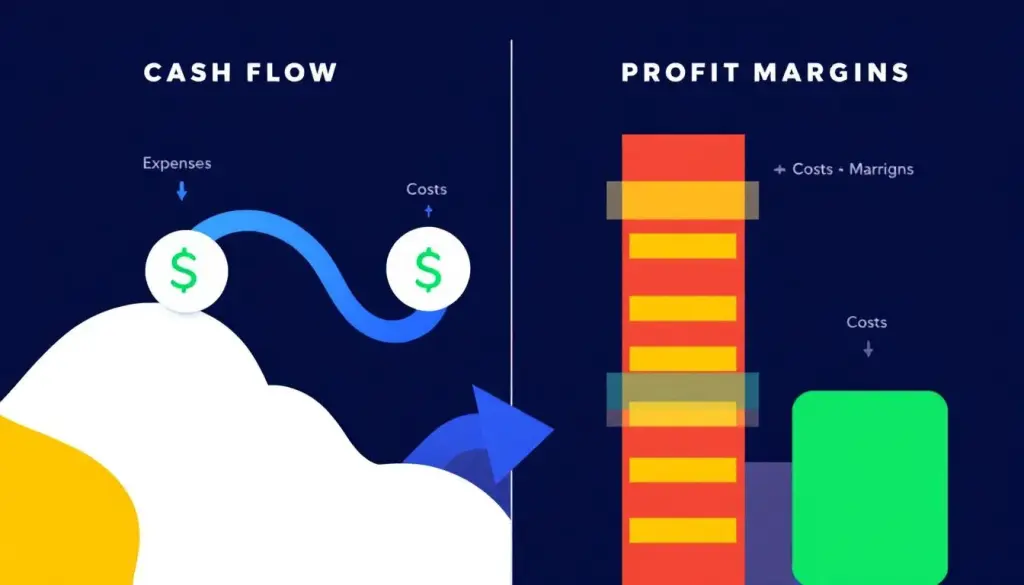
Profit tells you whether your jobs make money. Cash flow tells you whether you can make payroll on Friday. Contractors run short of cash on profitable work all the time, because money goes out for labor, materials and subs weeks or months before it comes back from the owner, and retainage holds part of it back until the job is done.
This guide covers why cash and profit split apart in construction, the warning signs, and how to close the gap.
Cash flow vs profit: the difference
| Profit | Cash flow | |
|---|---|---|
| What it measures | Whether your jobs and company make money over a period | Whether the money coming in covers the money going out, week to week |
| When it counts | As the work gets done | When the money actually moves |
| Where you see it | The income statement and the WIP schedule | The bank balance and the cash flow forecast |
| What goes wrong | A job loses money | You can’t pay the bills on a job that’s making money |
Why profitable contractors run out of cash
- Retainage. Owners and general contractors hold back part of every payment, often 5% or 10%, until the job is finished.
- Underbillings. You’ve done the work and paid for it, but you haven’t billed it yet.
- Slow pay. Pay applications get approved and paid on the owner’s schedule, not yours.
- Weekly payroll. Labor goes out every week, whether a draw came in or not.
- Upfront costs. Mobilization, materials, equipment and bonds come before the first payment.
- Change orders. On larger jobs the work often starts before the change order is approved, and the owner may approve it late, for less, or not at all.
- Growth. More and bigger jobs need more cash to carry them until they pay. Growing fast is one of the most common ways a profitable contractor runs dry.
- Loan principal payments and owner draws. They come out of cash but don’t show up as costs in profit.
A profitable job and a cash shortfall
Here’s a simple example. Say you bought $100,000 of materials for a job but have only billed $80,000 so far. The job can be profitable and you’re still $20,000 short until you bill the rest.
Here’s a pattern we see in real jobs. A contractor takes a job at a 7% or 8% margin because it fills a gap and keeps the crews busy. The owner holds back 10% retainage and may not release it until 90 to 120 days after the job ends. The retainage is bigger than the margin, so the contractor is cash negative for the whole job, even if it’s profitable in the end. Reserves, a line of credit or other jobs have to carry it.
Warning signs
- You’re profitable on paper, but your line of credit keeps climbing.
- You hold vendor payments to cover payroll.
- Underbillings keep growing on your WIP schedule.
- Retainage receivable keeps growing, even on finished jobs.
- You find out about a cash crunch the week it happens.
How to close the gap
- Bill on time, every time. Send pay applications on the first day the contract allows, and bill approved change orders right away.
- Watch underbillings every month. The WIP schedule shows which jobs are behind on billing.
- Chase retainage at closeout. Finish the punch list and paperwork so retainage gets released.
- Line up what you pay with what you’re paid. Match payment terms with subs and suppliers to when your customers pay, where your contracts allow.
- Know your break-even point. Know what each month has to bring in to cover what goes out.
- Forecast 13 weeks ahead. A 13-week cash flow forecast shows the shortfall before it happens.
- Put a line of credit in place before you need it. See how contractors work with banks and sureties.
How we help
We build and update your 13-week cash flow forecast, keep your WIP schedule current so underbillings show up early, and help you find the right financing. See our cash management services for contractors, read about construction cash flow problems, or see all our construction accounting services.
FAQs
What’s the difference between cash flow and profit?
Profit shows whether your jobs make money over a period. Cash flow shows whether the money coming in covers the money going out, week to week.
Can a profitable construction company run out of cash?
Yes. Retainage, underbillings, slow-paying owners, weekly payroll and fast growth can all drain cash on jobs that are making money.
Is cash flow more important than profit?
You need both, but cash decides whether you can pay your bills this week. A company can recover from one bad job; missing payroll is much harder to recover from.
How does retainage affect cash flow?
It holds back part of every payment until the job is finished, so money you’ve already earned sits with the owner, sometimes for months.
How can a contractor improve cash flow?
Bill on time, bill change orders as soon as they’re approved, track underbillings and retainage, line up payments with receipts, and keep a 13-week cash flow forecast.
What does poor cash management cost a contractor?
More than late fees. It means interest on borrowing you didn’t plan for, suppliers who tighten terms or want cash up front, work you have to turn down because you can’t fund the start, and payroll weeks that wear on everyone. A cash forecast shows the shortfall weeks ahead, while there’s still time to fix it.